
How System Dynamics Modelling Is Helping Local Authorities Redesign the NHS Health Check Programme
One of the key outcomes of WSP’s collaboration with Kent County Council was the publication of a peer-reviewed academic article documenting the modelling approach, scenario testing, and population-level insights generated through this work. The research sets out not only what the modelling revealed, but how system dynamics can support more confident, evidence-based commissioning.
Below is a summary of the insights and their implications for local authorities considering how best to shape the NHS Health Check programme.
Bringing whole-system insight to a single preventive service
WSP’s work with Kent built on an existing system dynamics cohort model originally developed to help local systems understand how risk factors, long-term conditions, demographics and service pathways interact over time. The newly developed health check module sits within this wider framework, allowing early risk detection and intervention to be modelled as part of a dynamic population system.
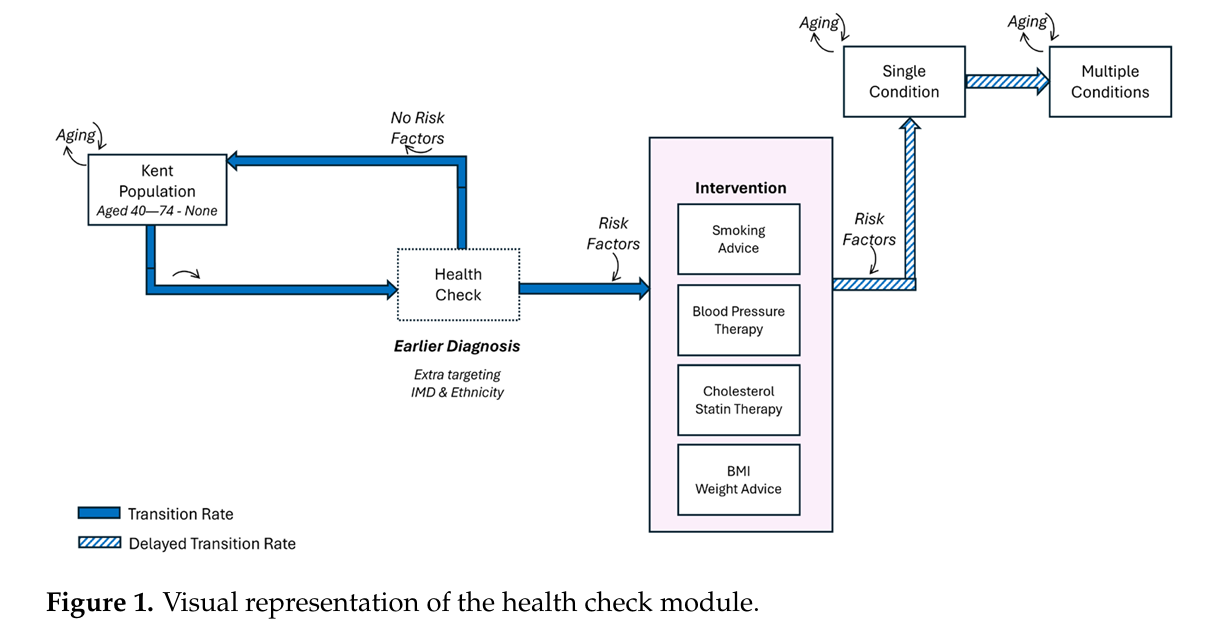
This system-level structure allows commissioners to see how changes to programme duration, attendance, and treatment uptake influence long-term outcomes such as disease incidence, healthy life expectancy, and years lived with disability.
What the modelling revealed
1. Long-term consistency matters more than short-term activity
Running the NHS Health Check programme for five years reduced cumulative cardiovascular disease incidence by over 6% compared with no programme. Extending delivery across the full 20-year period examined in the model prevented more than 23,000 cases of cardiovascular disease by 2043. This aligns with a broader theme seen across WSP modelling programmes: sustained, system-level interventions outperform episodic bursts of activity.
2. Treatment optimisation has greater impact than attendance campaigns
Increasing treatment uptake for hypertension and high cholesterol by 50% had a larger impact on reducing disease incidence than increasing attendance in the most deprived quintile. For commissioners, this highlights that the biggest system gains occur after the health check—within the management pathway.
3. Targeted approaches provide equity benefits even when system-wide impact looks modest
Raising attendance in the most deprived quintile produced only marginal county-level change but generated the largest relative improvements within the most deprived districts.
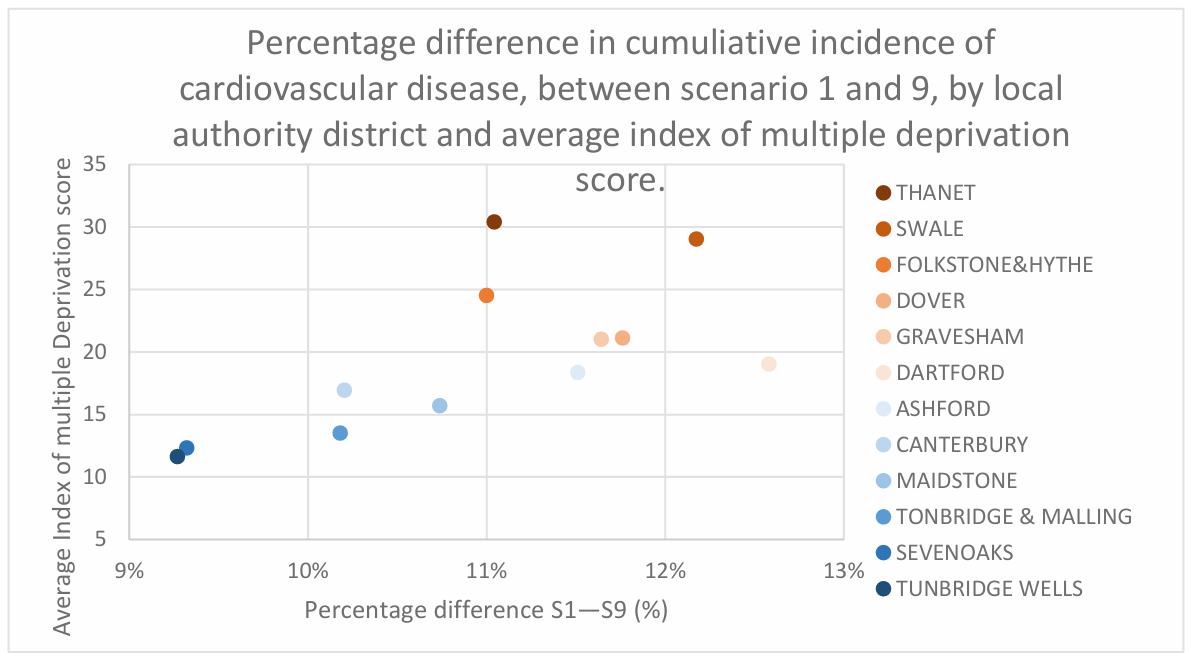
This is a familiar pattern in whole-system work: small shifts at population scale can mask meaningful equity gains at local level.
4. Healthy life expectancy improves more than overall life expectancy
Life expectancy changed minimally, but healthy life expectancy increased significantly—up to one additional year in the most deprived districts under the most effective scenario. This reflects a shift that many place-based systems aim for: reducing time lived in ill health, rather than simply extending life.
5. System benefits flow far beyond the health check service
The most effective scenario reduced years lived with disability by more than 350,000 across Kent. These avoided years of ill health have downstream implications for social care demand, workforce participation, and community wellbeing.
Supporting more confident commissioning decisions
The modelling provided Kent County Council with clarity on:
Which levers deliver the greatest long-term system benefit
How targeted approaches contribute to equity
Where changes are feasible within current delivery structures
How different commissioning choices would shape outcomes over 10–25 years
WSP’s role included developing the model, facilitating the stakeholder processes that informed assumptions, and supporting commissioners to interrogate the outputs in a way that aligned with real-world decision needs.
The publication of the article was one outcome of this work, capturing an approach that can now be replicated by other local authorities seeking to make evidence-based adjustments to their NHS Health Check programme.
Looking ahead: strengthening modelling for future commissioning
The work also highlighted several opportunities for even richer insight:
Segmenting populations by cardiovascular risk
More detailed modelling of general practice prescribing behaviours
The ability to test refined scenarios interactively
Stronger integration of equity analysis within outputs
These developments align with WSP’s wider commitment to providing systems with robust, accessible modelling tools that support transformation at place, system, and regional levels.